Friday, June 23, 2017

Ebola virus burial teams may have 'saved thousands of lives'

No comments:
They were ordinary people doing an extraordinary job in extremely dangerous times.
Now new research suggests Red Cross volunteers who helped bury most of the bodies of Ebola victims in West Africa could have prevented more than 10,000 cases of the deadly disease.
More than 28,000 people were infected with Ebola in 2014-2015. Of those, 11,310 people died.
The worst affected countries were Guinea, Liberia and Sierra Leone.
A major part of the response was ensuring the safe burials of people who had died of Ebola. The bodies of victims were particularly toxic.
Community funerals, where people helped wash the bodies of their loved ones, contributed to so many people becoming infected in the earlier stages of the outbreak.
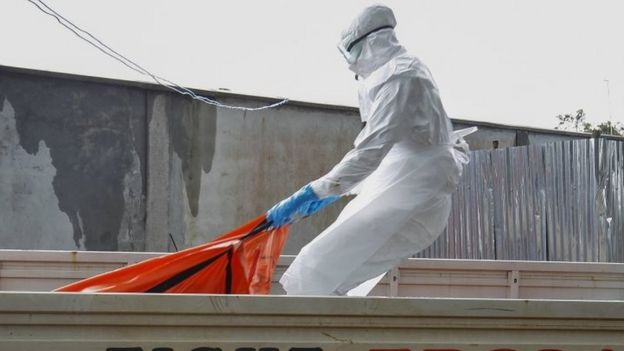
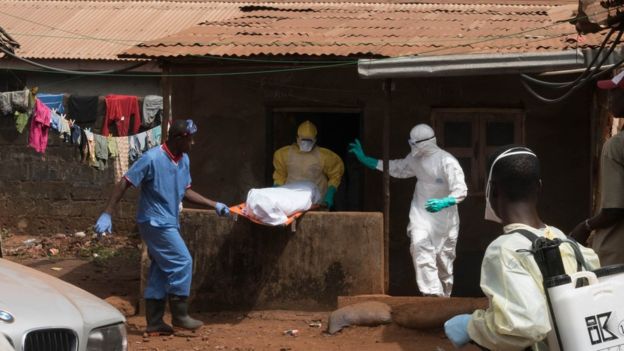
A Liberian health worker in a burial squad drags an Ebola victim's body for cremation in Monrovia (13 October 2014)Image copyrightEPA
Image captionMany Ebola burial workers were ordinary West Africans, such as teachers and college students
Ebola burial team in Freetown, Sierra Leone (file picture)Image copyrightMARK GEORGIOU
Image captionSome Ebola burial workers were stigmatised in their communities because of their work
Within months, the epidemic had become the worst public health emergency of modern times.
The study, published in the PLOS Neglected Tropical Diseases journal, used statistical modelling to measure the impact of the Red Cross safe and dignified burial programme.
Researchers focussed on 45 unsafe community burials and the 310 people who were identified as having had contact with the infected bodies. They found, on average, just over two people went on to develop Ebola for every unsafe community burial that took place.
The bigger risk was to those who cared for a loved one with Ebola before their death. Researchers found many more infections could have been prevented if the sick were treated in hospital rather than by their families and communities.
However, using these estimates, the study suggested safe and dignified burials by Red Cross volunteers prevented between 1,411 and 10,452 cases of Ebola.
The authors said these are conservative estimates.
They highlighted a number of limitations in the study, including the challenges of collecting very personal and sensitive information about funerals, and the length of time between when some of the burials took place and when the data was collected.

Ending the war

Hundreds of paid volunteers took on the grim task of collecting bodies from people's homes in full personal protective gear, while also having to manage the grieving families and communities.
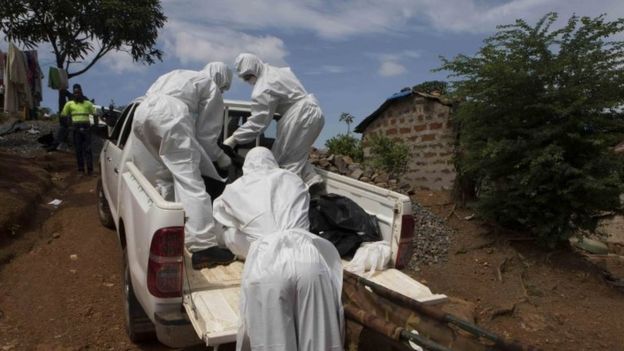
A burial team wearing protective clothing remove a body of a person suspected of having died of the Ebola virus in Freetown, Liberia (28 September 2014)Image copyrightREUTERS
Image captionIt is estimated that dignified burials prevented between 1,411 and 10,452 cases of Ebola
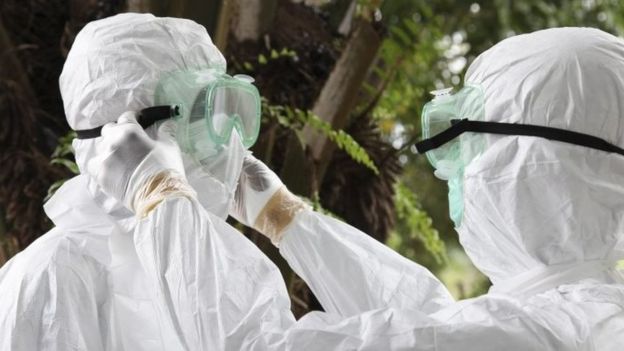
Liberian nurses put on protective clothing as preparation to carry the body of an Ebola victim for burial (08 August 2014)Image copyrightEPA
Image captionThe work of the burial teams is thought to have played a major role in reducing the impact of the Ebola virus
They were ordinary West Africans, such as teachers and college students. Many carried out the relentless and dangerous work for months.
Some were stigmatised in their communities, because people became scared they might bring the virus home with them.
In reality, they were helping to stem world's worst ever Ebola outbreak.
"It was very difficult work," said Red Cross volunteer Mohamed Kamara who I spent a day with as he collected bodies in Sierra Leone in January 2015.
"It's good news that people realise the impact of what we did to help end the transmission of Ebola," he said while reacting to the findings of the study from the capital Freetown.
"Some people didn't even want to come near us at that time.
"But the team we worked with helped give us the courage to do this important work… and we ended this war."

Red Cross safe and dignified burials

  • Teams managed over 47,000 burials
  • Carried out more than 50% of all burials during the outbreak
  • All deaths at home were presumed to be Ebola
  • About 1,500 Red Cross volunteers involved in burials
Ebola 'super-spreaders' cause most cases
what is South Korea's presidential scandal?

No comments:
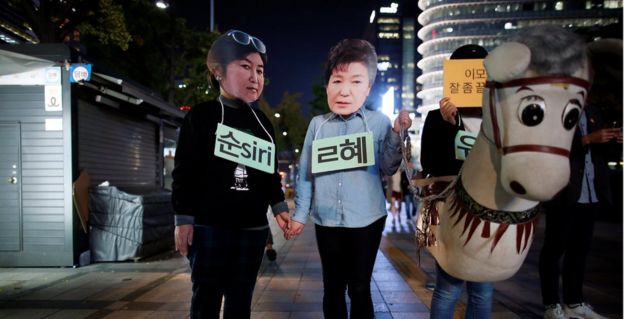
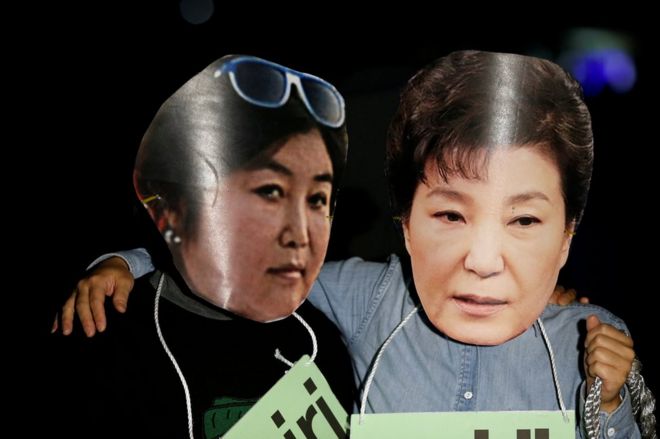
Protesters wearing cut-outs of South Korean President Park Geun-hye (R) and Choi Soon-sil attend a protest denouncing Park over a recent influence-peddling scandal in central Seoul, South Korea, 27 October 2016.Image copyrightREUTERS
Image captionThe scandal is centred on the close relationship between Ms Park and Ms Choi
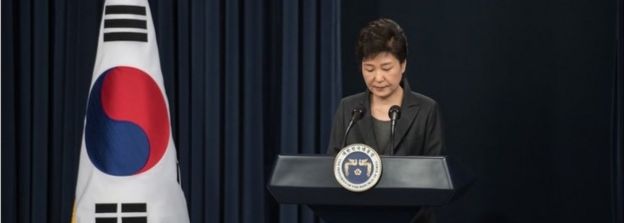
South Korea's President Park Geun-hye has become the country's first democratically elected leader to be forced from office.
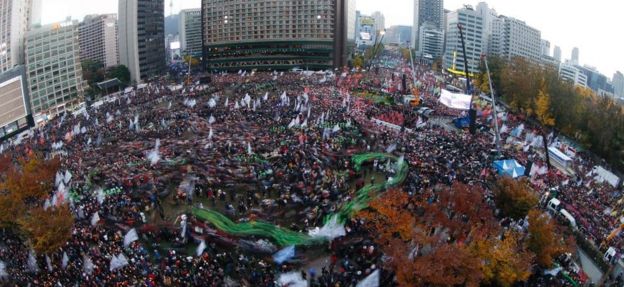
That dubious honour was imposed on her when, on 10 March, judges unanimously upheld parliament's decision in December to impeach her over a corruption scandal.
That scandal, which has generated huge protests, centres on her relationship with an old friend, and has brought allegations of cult activities, influence-peddling and leaks of classified information.

What is the relationship at the heart of the scandal?

In 1974, Park Geun-hye's mother was killed by a North Korean spy who had intended to kill Ms Park's father, then-military leader Park Chung-hee. Ms Park, then aged 22, became a stand-in first lady for her widowed father.
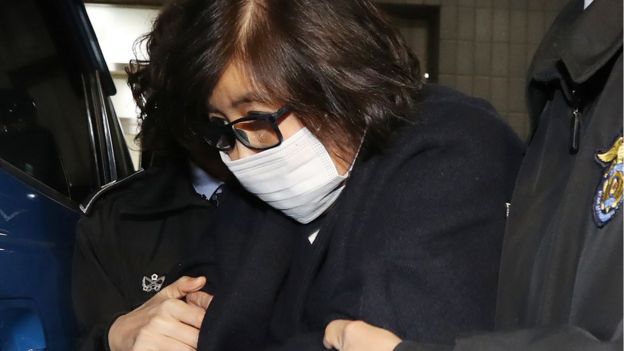
Choi Soon-SilImage copyrightAFP/GETTY
Image captionMs Choi has returned from abroad to face questioning
It was then she got to know Choi Tae-min, a pseudo-Christian leader who set up a cult called The Church of Eternal Life. He said he had been visited by the soul of Ms Park's late mother who asked him to guide her.
He became Ms Park's mentor, while also amassing considerable wealth and power.
When President Park senior was assassinated by his head of intelligence in 1979, there was speculation it was because the spy chief was worried the president was being manipulated by the man dubbed "the Korean Rasputin".
By this point Ms Park was firm friends with Mr Choi's daughter, Choi Soon-sil. Their critics believe Ms Choi perpetuated her father's habits.

Why has the friendship become problematic?

On 20 November, Ms Choi was charged with various offences, including abuse of authority, coercion, attempted coercion and attempted fraud. She is now on trial.
Few claims have been off-limits in the media coverage, with some reports going as far as suggesting the president is a puppet who hosted shamanist rituals at the presidential compound. But many of the lurid claims are unsubstantiated.
Protesters wearing masks of Choi Soon-sil (left) and President Park Geun-hye (centre), alongside someone dressed as a donkey, at a protest denouncing President Park on 27 October 2016 in Seoul.Image copyrightREUTERS
Image captionWith no immediate family, President Park came to rely too much on her friend, critics claim
Ms Choi is accused of using her presidential connections to pressure companies for millions of dollars in donations to two non-profit foundations she controlled.
The claims have even swept up Samsung in the investigation - the firm is one of eight that has admitted making payments to the foundation, but denies it did so in return for any favours.
President Park is alleged to have been personally involved, instructing Ms Choi and two presidential aides to collect money for the launch of Ms Choi's foundations, according to prosecution documents submitted to the court.
South Koreans protest against President Park Geun-Hye in Seoul on November 12, 2016.Image copyrightAFP
Image captionProtesters have marched in vast numbers to demand Ms Park stands down
Ms Choi is also accused of having received large numbers of confidential government documents from Ms Park, via an aide. These allegedly included information about ministerial candidates and North Korea.
There are even claims Ms Choi took advantage of the president's wardrobe budget - buying cheap outfits and keeping the change.

What do the two women say?

They have both apologised, but it remains unclear exactly what for.
When she was first questioned in October, Ms Choi said she had committed an "unpardonable crime", though her lawyer said this was not a legal admission of guilt.
President Park has herself admitted some lapses. She says she did consult Ms Choi for advice, and that she helped her edit her speeches, but that this stopped once she had a team of advisers in place.
Witnesses have claimed that Ms Choi received briefings and official papers long after that occurred. Documents were also discovered on an unsecured tablet computer found in an old office of Ms Choi's.
The tone of the president's pronouncements has changed over time. She began with opaque apologies: "Regardless of what the reason may be, I am sorry that the scandal has caused national concern and I humbly apologise to the people."
South Korea's President Park Geun-Hye (4 Nov 2016)Image copyrightAFP
Image captionMs Park said she had "put too much faith" in her friendship with Ms Choi
But she has moved on to "heartbroken" public confessions of naivety: "Sad thoughts trouble my sleep at night. I realise that whatever I do, it will be difficult to mend the hearts of the people, and then I feel a sense of shame."
She had said she was willing to be questioned by investigators, but has so far resisted their attempts to speak to her.
Her spokesman said the prosecutors' allegation that she colluded with Ms Choi was "deeply regrettable" and "but a house of cards built on repeated imagination".

So how is Samsung involved?

Samsung's de facto head, Lee Jae-Yong, is now on trial on a string of corruption charges, including bribery and embezzlement.
Prosecutors allege Mr Lee, heir to South Korea's largest conglomerate, approved payments of 41bn won ($36m, £29m) to Ms Choi's foundations, to win government support for a big restructuring of Samsung.
He denies the allegations, as do four other Samsung executives facing trial.

Lee Jae-yong

Samsung's heir apparent

  • - Grandson of Samsung founder Lee Byung-chul, son of current chairman Lee Kun-hee.
  • - Also known as Jay Y Lee, the 48-year-old has spent his entire career in the company.
  • - Is vice chairman of Samsung Electronics and was nominated to join the firm's board in October 2016.
  • - Despite his arrest, still widely expected to take overall control of Samsung.
  • - Critics say his rise through Samsung has been due to his birth, not his business experience.
Getty Images
Mr Lee, also known as Jay Y Lee, is currently vice-chairman of Samsung Electronics. But since his father, Lee Kun-hee, suffered a heart attack in 2014, he is considered de facto boss of the entire Samsung Group conglomerate.
In a December parliamentary hearing, Samsung admitted giving a total of 20.4bn won to two foundations, but denied seeking favours.
Mr Lee also confirmed the firm gave a horse and money to help the equestrian career of Ms Choi's daughter, Chung Yoo-ra, something he said he regretted.
Investigators are assessing whether the payments bought support for a controversial merger of two Samsung affiliates.
Some investors opposed the deal, saying one of the affiliates's shares were undervalued, but support from a major shareholder, the state-run National Pension Service (NPS), helped the deal go through.
The official who oversaw the NPS has since been charged with putting pressure on managers to approve the merger, which strengthened Mr Lee's control over a key part of the conglomerate.

Is anyone else involved?

Several former presidential aides have been investigated.
An Chong-bum, Ms Park's former senior secretary for policy co-ordination, has been charged with abuse of authority, coercion and attempted coercion, and Jung Ho-sung is accused of passing classified presidential documents to Ms Choi.
Local media have also been busy finding colourful associates of Ms Choi who were close to the president, including various celebrities and her personal trainer, who was appointed as a presidential aide.
Image copyrightEPA
Image captionAll the judges presiding over Ms Park's trial voted for impeachment

What now?

The impeachment verdict against Ms Park stripped her of presidential immunity.
Prosecutors then charged her with bribery, coercion, abuse of power and leaking state secrets in April 2017. Preliminary hearings in her trial began in early May.

Brexit: EU citizens deal fails to allay fears

No comments:
Proposals from Theresa May to allow EU citizens to stay in the UK have not allayed the fears of those affected.
Mrs May unveiled plans at a Brussels summit on Thursday, which would grant a new "UK settled status" to EU migrants who had lived in the UK for five years.
But Europeans living here said they are still "panicked" and the proposals give "more questions than answers".
Britons living in the EU are also worried about what it will mean for a reciprocal deal.
The settled status would give EU citizens the right to stay and access healthcare, education and other benefits, after the UK's exit deadline - which is 30 March 2019.
The prime minister also promised to streamline the system, including doing away with an 85-page permanent residency application form.
However, no cut-off date has been specified from Downing Street and further details of the plans will not be released until Monday.
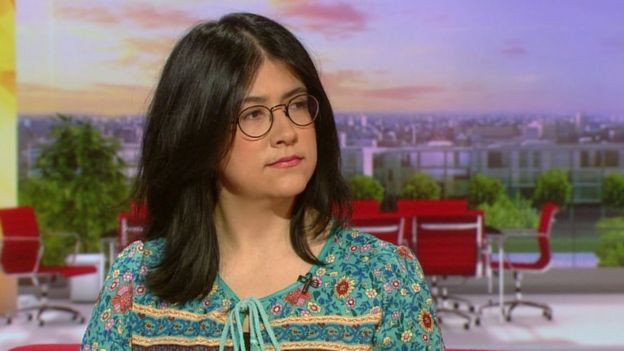
Bulgarian Maria Spirova, who has been living and working in the UK for five-and-a-half years, said she was still concerned about what the scheme would mean for her future, despite the announcement.
"I am panicked on the inside," she told BBC Breakfast. "I arrived here before 2014... but [the proposals] open more questions than they answer.
Maria Spirova
Image captionMaria Spirova worries if she will be able to stay living and working in the UK
"It was the British public that voted to leave, we didn't vote, and we have had no control over our future as part of this country.
"With Mrs May saying there could be no deal, what happens to us?"
Anne-Laure Donskoy, founding member of the 3million - which aims to protect the rights of EU citizens living in the UK - said the offer was "neither fair, nor really serious".
She told BBC Radio 4's Today programme: "The announcement that Theresa May made really falls short of our expectations.
"It is like a teaser this statement, it gives you general direction of travel potentially, but there are things in the statement that need to be unpicked."
On the other side of the Channel, British people are also concerned about what their futures hold.

'We feel betrayed'

Glynis Whiting has been living in Brussels for 20 years and has taken the decision to adopt Belgian citizenship because of her concerns.
"People are worried, people are angry and we have had 12 months of this," she told Today. "We didn't get a vote and we feel betrayed and disappointed."
John Brown has been living in Belgium for 21 years. He said: "It is when you get down to the nitty gritty, you uncover all the real issues, and I don't think any generous offers will get down to the real details."
But speaking at the start of the second day of the EU Summit, Mrs May said she wanted to reassure EU citizens in the UK that "no one would have to leave", adding: "We won't be seeing families split apart."
She said there had been a "constructive start" to the talks, and that the UK had "set out the issues that we want to start talking about early in the negotiations" - including citizens' rights.
Labour's Keir Starmer, the shadow Brexit secretary, criticised Mrs May's plans as "too little too late" and "falling far short" of the unilateral guarantee he says his party would offer. Liberal Democrat leader Tim Farron also said the proposals left too many unanswered questions.
However, German Chancellor Angela Merkel told reporters that the offer was "a good start".
Both the UK and the rest of the EU say they want to come to an arrangement to secure the status of the 3.2 million EU citizens in the UK and the estimated 1.2 million Britons living in EU countries.
The European Union has said they should continue enjoying the same rights, enforceable by the European Court of Justice, but the UK has said rights should be upheld by British courts.
UK opposition parties had urged the government to make a unilateral guarantee to the EU migrants - but ministers have insisted a reciprocal deal is needed to ensure British expats are protected.
 
Copyright ©2016 Top News Today in the world • All Rights Reserved.
Template Design by BTDesigner • Powered by Blogger